RECENT trial results in the low rainfall region of Western Australia showed no yield benefit from shallow incorporation (to 20 cm depth) of lime for managing subsoil acidity, as acidity issues in the deeper 20-40 cm depth continued to restrict root growth.
In this environment, growers can achieve effective outcomes and save time and money by avoiding the additional shallow tillage.
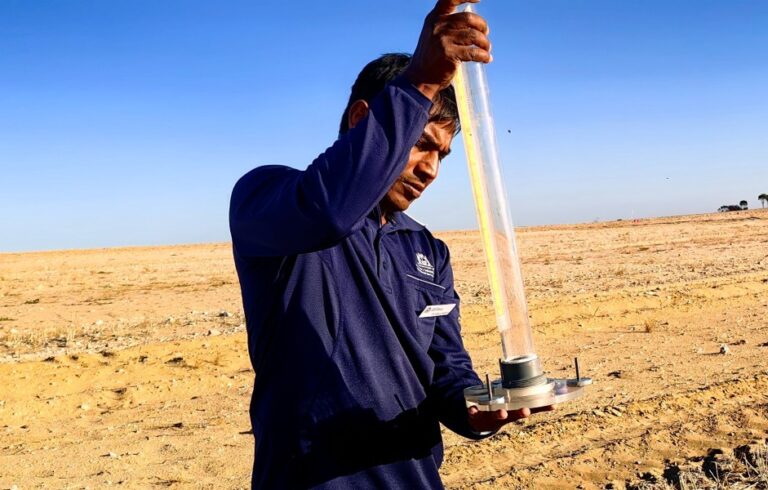
That’s the advice of DPIRD Principal Research Scientist Dr Gaus Azam, who has been monitoring a liming trial site on a sandy loam soil at Kalannie, three hours north-east of Perth, since 2017.
In acidic soils, increased aluminium solubility restricts root growth reducing water and nutrient uptake, highlighting the importance of managing soil acidity effectively.
Agricultural lime is commonly applied to soil by growers to increase soil pH, but it can be slow to reach the subsoil when applied at the surface without incorporation.
Over a four-year period (2017 to 2020), surface lime applied at Kalannie didn’t reach below 10 cm.
When incorporated using shallow tillage, soil pH increased and extractable aluminium concentrations decreased, but improvements were only in the 0-20 cm zone.
Shallow incorporation of lime didn’t provide additional yield benefits over surface liming, as the strongly acidic subsoil (pH less than 4 at 20-40 cm depth) continued to restrict root growth.
Despite these results, Dr Azam said growers shouldn’t be alarmed.
“Surface liming is still effective where the topsoil is poor,” he said. “While we encourage subsoil liming, it is more challenging, and not all growers are ready for it based on the tools they have.”
Dr Azam added that some growers still used ploughs better suited to shallow tillage, with the hope that any incorporation of lime would benefit the soil.
“Research from Kalannie and the same trial in Merredin shows that when it comes to shallow incorporation of lime there is no benefit, it is just burning diesel,” he said.
“It improves the soil pH to 20 cm, but there is no yield benefit as the crops had limited access to the subsoil water and nutrients in this low rainfall environment.
“The trial has been going for eight years now and we’re still not seeing any difference with shallow incorporation, so why disturb the soil if we are not fixing acidity deeper in the profile?”