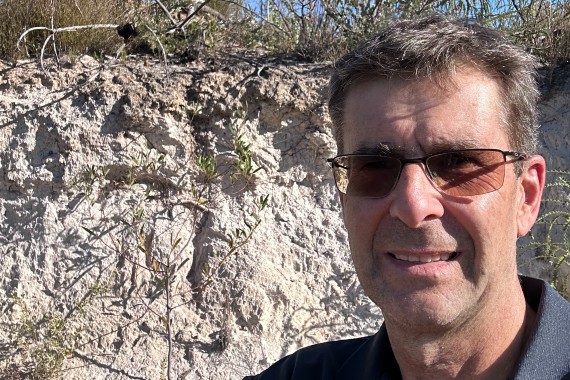
PRINCIPAL Research Scientist David Hall will reflect on a four-decade commitment to the industry when he delivers Soil Science Australia‘s Boodja lecture on November 7.
Since 2012, the annual lecture has promoted the “outstanding and prominent aspects of soil science in Western Australia”, with “Boodja” a common Noongar word for land.
While Hall’s presentation will focus on Beach sands and sodic clays: the role of soil science in transforming WA soils for crop production, he is aware of peer interest in his looming retirement from the Department of Primary Industries and Regional Development (DPIRD).
“It’s a great honour to present the Boodja lecture, even more so when retirement is imminent,” he said.
Starting his research career in New South Wales in the early 1980s, Hall worked on amelioration strategies for irrigated Vertisols and Chromosols with physiochemical limitations.
Seeking a sea change, Hall and his young family relocated to Esperance in 1993, where soils and landscapes were completely different to anything he had previously experienced. His initial research was spent identifying perennial and annual farming systems that could reduce recharge to manage salinity.
However, without a feasible biological solution, Hall found that growers were soon supportive of management strategies to address related constraints such as water repellence, acidity and compaction on the sandplain soils.
“We determined that we’d have to revegetate 30 to 50% of the total area of farmed land with perennial species in order to get hydrological control, which would then limit salinity,” he said.
“Given that this was not economically feasible, we thought about other ways we could improve productivity across the landscape.
“That’s when my research started to focus on soil amelioration. Coincidentally, at that time land prices started to increase, and so growers were thinking, ‘Well, it’s harder to get new land, therefore I’ve probably got to look after the land I’ve got a lot more effectively’.”
Hall said that working with an adaptive farming community had provided the perfect setting for DPIRD’s soil research and extension.
With the aid of long-term research investment, significant inroads have been made into managing soils with multiple constraints – in particular sandplain soils, where reducing water repellence, compaction, nutrient limitations and acidity has helped to double yields within the past 15 years.
For heavy clay soils, the soil limitations to crop production have been harder to manage, however recent research is indicating eventual dividends.
“We’ve had support from the farmers, we’ve had support from the grower groups, and we’ve had a lot of support from the Grains Research and Development Corporation to do the work that we believe is valuable to the growers,” Hall said.
The 2025 Annual Boodja Lecture will be held at State Library Theatre on November 7 from 3 pm to 5 pm. Tickets are free and available here.