AGGREGATE: NEWS & EVENTS
Soil ecologist’s step into national soil innovation
MURDOCH University soil ecologist Ramesha H Jayaramaiah is embracing “the realities of the field” as he embarks on a new postdoctoral research role focused on innovative soil technologies.
Dr Jayaramaiah’s position is part of a national project led by Adelaide University with Murdoch University contributing to the Western Australian component alongside local grower groups and industry partners. The broader project spans five states including South Australia, New South Wales, Tasmania, Western Australia and Victoria, providing a strong national context for evaluating innovative soil management approaches.
Working within the Sustainable Land Management Group as part of SoilsWest, Dr Jayaramaiah’s research will help examine how innovative soil technologies and improved amendment delivery can influence soil constraints, nutrient availability and biological processes, with the broader aim of supporting more resilient and climate-smart cropping systems.
“One of the exciting things about this project is that it looks at soil performance in a more integrated way,” Dr Jayaramaiah says.
We’re interested not only in whether these technologies work, but how they influence soil chemistry, physical constraints, nutrient availability and the biological life in soil across different environments.
One example being explored in the Western Australian trials is the use of micronised lime to address soil acidity.
“A farmer may usually apply several tonnes of lime per hectare, so one of the questions we are asking is whether a more finely processed product can improve amendment efficiency and help us achieve comparable benefits with lower application rates,” Dr Jayaramaiah says.
“We are also interested in whether improved amendment properties and delivery may help address acidity more effectively through the soil profile, but that is exactly what this project is designed to test under field conditions.”
Throughout April and May, the project team expects to apply micronised lime, gypsum and other treatments to field trial sites with the Facey Group at Wickepin (215 kilometres south-east of Perth) and with the Mingenew-Irwin Group at Arrino (321 kilometres north), before sowing wheat. Controlled glasshouse studies will run in parallel to further assess treatment responses.
Because the same broad treatment approach is being examined across trial sites in several states, the project will also allow researchers to compare responses across different soils, climates, and farming systems. Soil samples and data will be shared across the collaborating teams to build a stronger national evidence base.
With his background in plant-soil-microbe-fauna interactions and nutrient cycling, Dr Jayaramaiah is also particularly interested in how innovative soil technologies may influence microbial and soil fauna responses.
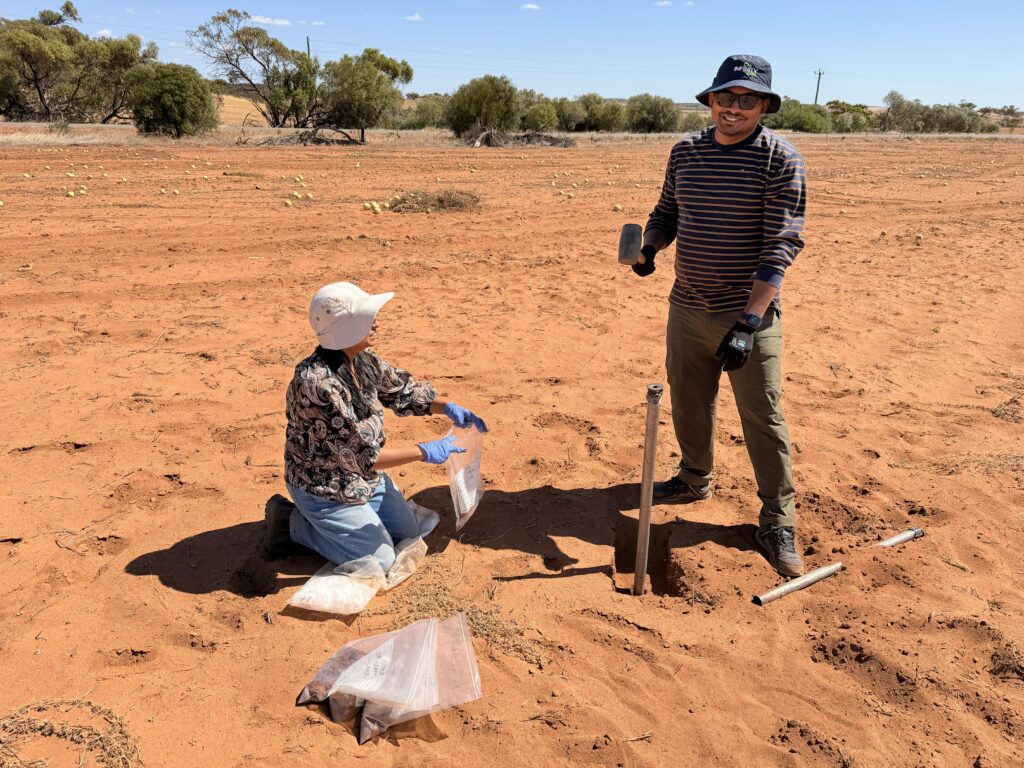
“What I have particularly enjoyed so far is getting into the field early in the role – undertaking baseline soil sampling, visiting sites in very different regions, and meeting both the grower groups involved in the trials and the DPIRD teams helping establish the treatments,” he says.
“Staying close to that field context is very important to me, because it keeps the science grounded in real soils, real environments, and real challenges faced by agriculture.”
Dr Jayaramaiah says the field work is another important step in his professional development since joining Murdoch University in 2023, providing more opportunities to connect laboratory knowledge with practical agricultural systems.
“Now I get more opportunities to work with what’s happening in the ground, not just the laboratory,” he says.
“I can learn from farmers, grower groups and field practitioners, and bring those insights back into the science.”
The Innovative Soil Technologies to Foster Resilience and Climate Smart Crop Production in Australia Project is supported by the Australian Government through funding from the Climate-Smart Agriculture Program under the Natural Heritage Trust, administered by the Department of Agriculture, Fisheries and Forestry (DAFF).
MORE STORIES

Research spotlights soil fauna’s role in nutrient cycling
A review led by Dr Ramesha Jayaramaiah provides new insights into how soil fauna may help regulate nitrogen cycling and support more sustainable agricultural systems.

EasyDiesel tool calculates deep ripping decisions
The Department of Primary Industries and Regional Development (DPIRD) has released a tool for farmers to calculate the ongoing viability of their ripping program using current fuel prices.

Register now for the 2026 Soil Science Australia National Conference
Western Australia is hosting the conference on Whadjuk Noongar Boodja in Boorloo (Perth) from November 1-5, 2026.

Regional nutrition workshops kick off in Moorine Rock
The first SoilsWest-GRDC regional soil and plant nutrition workshop was held in the Wheatbelt town on March 4.