AGGREGATE: NEWS & EVENTS
This combination is sublime
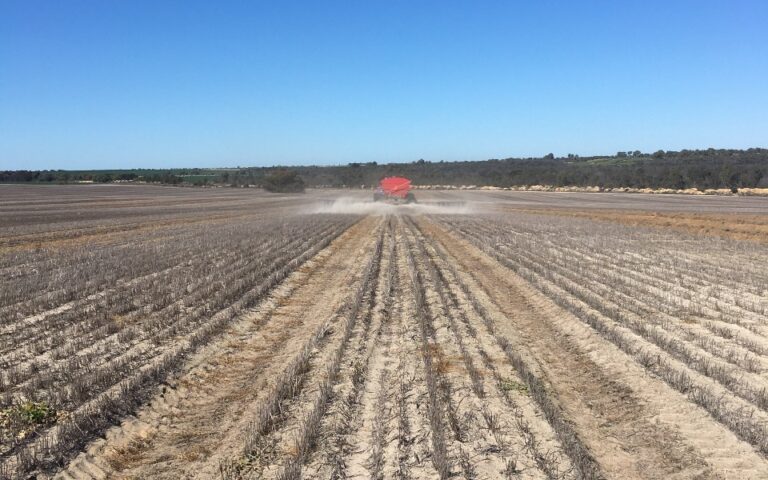
The Department of Primary Industries and Regional Development (DPIRD) Lime Series highlights the outcomes of ongoing research into agricultural liming and provides timely, practical information on the application of lime for Western Australian growers.
We hope you enjoy this selection of articles and papers.
FORTY-FIVE AND LIME might just be the magic formula when ameliorating soil compaction and acidity.
Research undertaken by a team of DPIRD soil scientists confirmed that in soils with compacted and acidic subsoil, loosening the high-strength soil to 45 cm, and then incorporating lime at that depth, effectively reduced compaction, raised soil pH and improved root access to soil water and nutrients.
This was the result of work undertaken by the scientists who conducted a trial on a sandy loam soil at Kalannie (low rainfall), with the combination of loosening and liming clearly the most effective treatment.
Loosening the soil through tillage proved a critical step in addressing subsoil constraints, as compacted soils force plant roots to grow laterally in search for water and nutrients. This increases the energy plants allocate to growing root biomass to allow for greater exploration for nutrients, such as nitrogen (N), phosphorus (P) and potassium (K), a shortage of which can limit above-ground growth and grain development.
Root growth in compacted soils is severely restricted at soil strengths above 2.5 MPa. This trial site had a soil strength of 3.5 MPa.
Loosening the soil to 45 cm without liming provided some yield benefit. However, the subsoil remained acidic, restricting the plants’ ability to effectively utilise nutrients.
To gain a stronger yield benefit, both constraints of compaction and acidity need to be addressed.
“Being able to incorporate lime to 45 cm after loosening made a huge difference,” DPIRD Principal Research Scientist Dr Gaus Azam said.
“We saw an increase in the uptake of N, P, and K by these plants that we wouldn’t have seen with loosening alone.”
This research is being undertaken with investment from DPIRD and GRDC in the Soil Water and Nutrition (SWAN) Strategic Collaboration, DAW2407-001SPX.
MORE STORIES

Soil ecologist’s step into national soil innovation
Dr Ramesha H Jayaramaiah’s new project role will give him more opportunities to connect lab knowledge with practical agricultural systems.

Research spotlights soil fauna’s role in nutrient cycling
A review led by Dr Ramesha Jayaramaiah provides new insights into how soil fauna may help regulate nitrogen cycling and support more sustainable agricultural systems.

EasyDiesel tool calculates deep ripping decisions
The Department of Primary Industries and Regional Development (DPIRD) has released a tool for farmers to calculate the ongoing viability of their ripping program using current fuel prices.

Register now for the 2026 Soil Science Australia National Conference
Western Australia is hosting the conference on Whadjuk Noongar Boodja in Boorloo (Perth) from November 1-5, 2026.