AGGREGATE: NEWS & EVENTS
Finding the soil re-engineering ‘sweet spot’
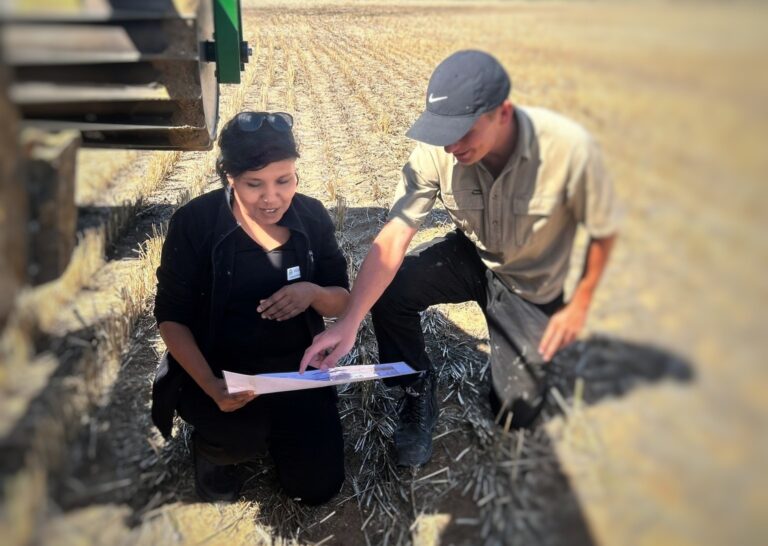
SCIENTISTS from the Department of Primary Industries and Regional Development (DPIRD) are hopeful of further soil re-engineering success as an important trial at Grass Valley, Meckering, some 130 kilometres east of Perth, enters its second year.
The trial site, on a property owned by grower Ty Fulwood, has been re-engineered to improve the deep sands’ water-holding and nutrient-holding capacities, and to ameliorate soil acidity and subsoil compaction.
The objective was to increase the soil’s inherent clay content from below 3%, to between 5% and 10%. This involved incorporating clay and lime at depths from 0-20, 20-40, 40-60, and 60-80 cm.
To achieve the targeted 5% clay content, substantial clay inputs were required depending to what depth the clay was incorporated: 375 t/ha (0-20 cm), 750 t/ha (0-40 cm), 1125 t/ha (0-60 cm), and 1500 t/ha (0 to 80 cm).
Bulk kaolinite clay deposits, sourced from a corner of Mr Fulwood’s paddock and known to be free from toxicities, had only 35% clay – hence the high rates.
“We want to find our limit – the sweet spot,” says DPIRD Research Scientist Kanch Wickramarachchi, who led the trial establishment and management alongside DPIRD Principal Research Scientist Gaus Azam (project manager), The University of Western Australia’s Dr Yinglong Chen and the wider DPIRD research team.
Early results suggest Ms Wickramarachchi and her colleagues are on the right track.
So far, the greatest improvement in Scepter wheat yield has been achieved through deep incorporation of 1500 t/ha of clay and 5 t/ha of lime to 80 cm, together with deep ripping. This treatment produced a three-fold yield increase compared to the non-re-engineered paddock control.
Ms Wickramarachchi says the research has been focused on making any successful techniques and outcomes adoptable for growers.
“In the previous phase of re-engineering, the intent was to identify the theoretical, or technical potential limit of re-engineering soils – trying to find how far we could push things before assessing feasibility and cost,” she says.
“We dug layer by layer, set the soil aside, mixed clay and lime ameliorants in, and then put it all back together like a layered cake. It was very much exploratory research.
The current phase, funded through the Soil Water and Nutrition (SWAN) collaboration between the Grains Research and Development Corporation (GRDC) and DPIRD, builds on key learnings from the initial phase and aims to squeeze every bit of grain out of every millimetre of rainfall.
“The Grass Valley trial is one of the newer grower-scale re-engineering sites set up under SWAN, covering about 2.5 hectares,” she continues.
“It’s tackling some tough soil constraints in a deep sandy paddock, where wheat yields have historically sat around 1.2 tonnes per hectare. To turn things around, we’re using grower-adoptable mechanical approaches: spreading clay and lime on the surface, deep mixing it through with rotary spaders, and breaking up hardpans with deep ripping to help re-engineer the soil profile.”
Ms Wickramarachchi says the trial was co-designed by the DPIRD research team, Mr Fulwood, his agronomist Tim Boyce, and machinery operators. Additional input came from other WA growers including John Snooke, the SWAN Management Committee and the SWAN Industry Advisory Group.
Since implementation of the re-engineering work in February 2025, day-to-day agronomic decisions such as seeding rates, row spacing, fertilising and pest management have been the grower’s call.
Ms Wickramarachchi says around 400 farmers had visited the trial site during 2025 growing season and are looking forward to the longevity of the treatments. They have asked how long the benefits of the clay and lime will last, and what the return on investment will be, with many farmers hoping the benefits extend well beyond a decade.
Ms Wickramarachchi and the research team are also looking into the nitrogen (N) fertiliser management of the re-engineered soil profiles, including N requirements for crop growth and potential N losses through leaching.
“Last year we got a bit behind with seeding and ended up with a dry grain-filling period, which didn’t do us any favours for hitting yield potential,” she says. “This year we’re aiming for a better finish, and I reckon we’ll see a much better result.
“Building on our previous work with deep root systems through soil re-engineering, I’m keen to get a better handle on the underlying processes – especially how root growth dynamics interact with nutrient uptake and percolation losses.
“It’s a supporting line of work alongside the main trial objectives.”
This research is being undertaken with investment from DPIRD and GRDC in the Soil Water and Nutrition (SWAN) Strategic Collaboration, DAW2407-001SPX.
MORE STORIES

A quick dig with … Lyn Abbott
The University of Western Australia’s Emerita Professor Lyn Abbott AM reflects on an academic research and teaching career that recently culminated in national recognition. Congratulations, Lyn.

Soil education roles open for national project
Murdoch University is inviting applications for two roles as part of the National Soils Education Opportunity (NSEO).

Mallee visit to share sandy soil research findings
Murdoch University’s Emeritus Professor Richard Bell will deliver nutrition, water and root depth information to researchers and growers at a South Australian event.

Expressions of interest open for soil testing programs
Western Australian farmers are encouraged to express their interest in soil testing programs provided by their state and federal governments.