AGGREGATE: FEATURE
A quick dig with … Lyn Abbott
PLANTS, soil science, mycorrhizas, and now Member of the Order of Australia.
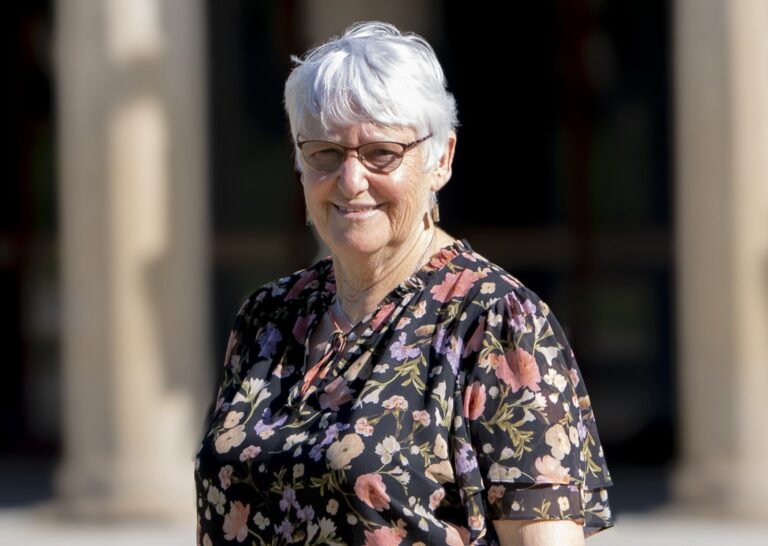
The University of Western Australia‘s Emerita Professor Lyn Abbott AM reflects on an academic research and teaching career that recently culminated in national recognition. Congratulations, Lyn.
I grew up with a father who was a garden guru.
We lived in a small country town in New South Wales and Dad was a primary school teacher. He joined the Soil Conservation Service of New South Wales because they had a free magazine, a journal. As an enthusiastic teacher, he sought out every resource he could possibly find. So, Dad exposed us to soil in a soil science context, and through his interest in landscape restoration. He drove us around with an eye on the environment, showing us gully restorations and soil pits.
We eventually moved closer to Sydney, and in 1966 I went to The University of Sydney to study botany. I then moved to Monash University to study take-all – a fungal pathogen in wheat – for my PhD. In 1973, Ian, my husband, studied plants and birds on the Galapagos Islands and I was fortunate to assist him. We arrived in Perth in 1974 when Ian was awarded a UWA postdoc to study island birds.
I got into soil in a roundabout way.
I had a connection with UWA from my years at Monash, because my PhD supervisor did his PhD with Professor Lex Parker in the Department of Soil Science and Plant Nutrition at UWA. When we arrived in Perth, I visited Lex.
The soil science group at UWA was strong across all disciplines – physics, chemistry, microbiology and plant nutrition. It was a hot spot of soil science internationally. I thought, ‘This is normal for a university’, but when I look back, it was quite exceptional. International soil scientists often came through Perth from Europe when visiting Australia, before the days of easy travel and emails.
My first position at UWA was a postdoc funded by the Australian Wool Corporation. This was initiated by Professor Lex Parker and Professor Alan Posner. I was fortunate to establish a mycorrhiza group at UWA with Professor Alan Robson. This ended up being a long-term collaboration with many PhD students and research staff investigating the role of mycorrhizas in agricultural soils and mine site restoration. Our research required expertise in soil science, plant nutrition and microbiology.
As a soil biologist, I have spent my career working on fungi that cannot be grown in the laboratory – arbuscular mycorrhizal fungi.
Because mycorrhizal fungi can’t be grown in isolation, our research was forced to focus on their ecology in field soils, not in the lab.
There are communities of mycorrhizal fungi in all soils, but it’s very difficult to quantify their benefits in farming systems. We know they can assist in the efficiency of phosphorus use, including fertiliser sources. We know they can access soil moisture in drying soils. We know they can assist in aggregating soil particles. It is a subtle fungal network that functions behind the scenes.
Their impact is similar to soil erosion in that there can be a cumulative effect over time, that cannot easily be measured on a daily or monthly basis. Many beneficial soil biological processes are also difficult to quantify.
I have presented many workshops – sitting with farmers, setting up microscopes, and talking about soil fertility.
It was very important for me to listen to farmers. My early workshops were organised by the Land Management Society. This organisation pioneered community-based land conservation initiatives, starting with ‘Know your soils’ and moving on to ‘Know your soil biology’.
I have enjoyed working with farmers. In the early days, the discussions were often focused on ‘What is soil fertility?’ The microscopes helped the conversation: ‘What does soil look like?’ and ‘What is living in the soil?’
Of course, I’ve worked on research projects on farms. You can’t learn everything about farming practices from textbooks. Farmers are often ahead of the science because they are on the ground. Our experiments are sometimes simplistic in comparison to the complexity of farming systems.
Working with farmers has given me context for what I do, especially for pasture research. That led us to setting up trials at the UWA Farm near Pingelly, WA, which built on our work with farmers and what we have learnt from them.
In my early days at UWA, legumes were a major part of agriculture in WA.
There’s been so much good soil science done over the years, especially in WA with our highly weathered soils. There have been many improvements in soil management. Farming systems have become more and more efficient and farmers are quick to adopt.
Plant diversity is important for soil biology. Roots help rejuvenate and improve soil health.
It is a wonderful honour to receive this award which recognises soil science.
I was very lucky to have started out in the early developmental stages of understanding mycorrhizas in farming systems. To work with Alan Robson was a highlight and we had amazing postgraduate students and research staff over more than 20 years. It was a long-term research team, and the research we did is still very relevant today.
I’m proud of how I enabled the integration of soil biology into the teaching of soil science at UWA. At one point, our soil science teaching probably had the strongest soil biological focus in Australia.
Apart from inoculating legumes with rhizobium or dealing with disease, soil biology wasn’t widely recognised 50 years ago. Scientists didn’t talk about soil health. Now soil health is a common topic.
I’m still at UWA, having retired 13 years ago, because I enjoy working on soil biology research with students and colleagues, and with the farming community.
Lyn Abbott's professional timeline
1974-1977 Research Fellow, Soil Science and Plant Nutrition, UWA
1977-1985 Research Officer, Soil Science and Plant Nutrition, UWA
1986-1989 Lecturer, Soil Science and Plant Nutrition, UWA
1990-1995 Senior Lecturer, Soil Science and Plant Nutrition, UWA
1995-2002 Associate Professor, Soil Science and Plant Nutrition, UWA
2002-2013 Winthrop Professor, School of Earth and Environment, UWA
2004-2007, 2009 Head, School of Earth and Environment, UWA
2010-2012 Vice Dean, Faculty of Natural and Agricultural Sciences, UWA
2014 Deputy Director, UWA Institute of Agriculture, UWA
2013-present Emerita Professor, Senior Honorary Research Fellow, UWA
Awards
1993 Australian Institute of Agricultural Science and Technology Fellow
2007 National Carrick Citation for Contribution to Teaching and Learning
2016 Soil Science Australia Society Fellow
2021 Inaugural General Jeffery Soil Health Award
2026 Inductee into the WA Women’s Hall of Fame
2026 Member of the Order of Australia
MORE STORIES

Finding the soil re-engineering ‘sweet spot’
DPIRD Research Scientist Kanch Wickramarachchi hopes grower-adoptable mechanical approaches can produce even greater wheat yields for her SWAN project trial.

Soil education roles open for national project
Murdoch University is inviting applications for two roles as part of the National Soils Education Opportunity (NSEO).

Mallee visit to share sandy soil research findings
Murdoch University’s Emeritus Professor Richard Bell will deliver nutrition, water and root depth information to researchers and growers at a South Australian event.

Expressions of interest open for soil testing programs
Western Australian farmers are encouraged to express their interest in soil testing programs provided by their state and federal governments.