AGGREGATE: FEATURE

A quick dig with … Chris Gazey

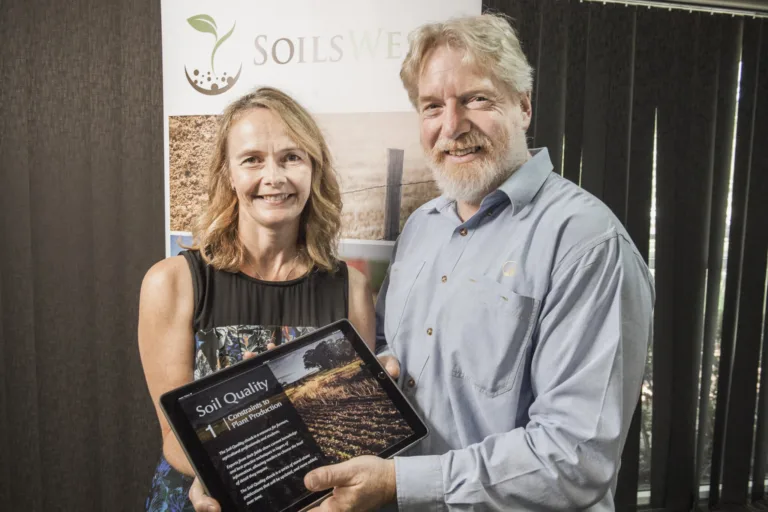
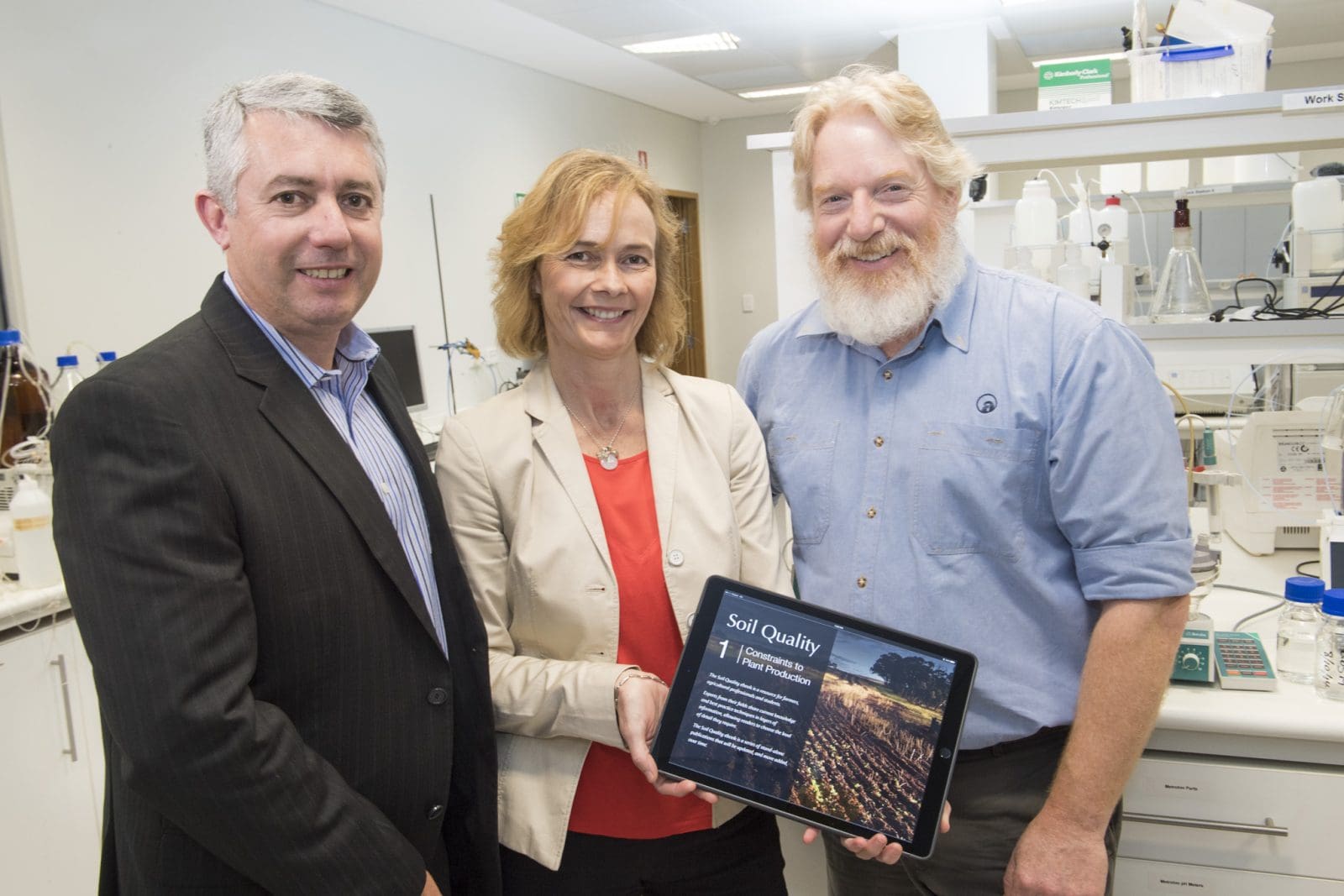
SoilsWest Co-Directors Fran Hoyle and Chris Gazey with the first Soil Quality ebook: Constraints to Plant Production.
X
LinkedIn
Email

RESEARCH, collaboration, information, an anniversary.

Chris Gazey, Department of Primary Industries and Regional Development (DPIRD) Principal Research Scientist and SoilsWest Co-Director, recounts the formation of the SoilsWest alliance and its impact over 10 years.

Happy birthday, SoilsWest.

When we decided to formalise SoilsWest, we thought about what it could add to what we already had.

By that stage, Fran Hoyle was working alongside Professor Daniel Murphy at UWA (The University of Western Australia) and starting to get SoilsWest on its feet. I was leading the soils group at DAFWA (The Department of Agriculture and Food Western Australia, now DPIRD).

When Fran left DAFWA to move over to UWA, there was a conscious decision made by the department to not pursue soil carbon or soil biology. The expertise and body of work moved with Fran. It left a gap and a need for us to collaborate.

We also recognised that not all institutions could do everything. We needed an understanding of how we could pool our resources and achieve more than the sum of the individuals; a non-competitive but challenging collaboration where each body was doing what they were good at.

CSIRO was excellent at modelling and high-level research. The universities were good at fundamental research, detailed glasshouse or laboratory investigations, and access to students. DAFWA had a strong regional presence, particularly when it came to the soils group – and it still has as DPIRD. We have a couple of staff located in Perth but major teams in Northam, Geraldton and Esperance, and smaller teams in Albany, Merredin and Katanning. This continues to strengthen our relationship with growers and access to regionally based field trials which help to translate research to adoption of new practices.

Support for the initial change was critical. We had tangible investment from both UWA and DAFWA, which enabled us to work. Mark Sweetingham, who was DAFWA’s Director General, and Kerry Regan, its Director of Grains, were among a range of people who got behind the alliance.

One of SoilsWest's early successes was a multi-disciplinary, multi-institutional workshop.

The workshop was put together to address soil nutritional constraints and develop a proposal for a project that the group was eventually successful in securing.

It sounds straightforward but we had people who normally wouldn’t sit in the same room together, gathering around tables to discuss and plan what was required. Out of that came a large proposal that had buy-in from all of the different institutions.

It included components of CSIRO, the universities and DAFWA, and it worked really well. It was a milestone.

Since then, the SoilsWest arrangement has felt like a natural fit.

For this reason, it can be easy to overlook some of its achievements. The collaboration has had a natural way of working – something that’s been a characteristic of my career over the last 30 or 40 years. 

When I first started work at UWA in the 1980s with Professor Alan Robson and Emerita Professor Lyn Abbott, collaboration was normal. Alan was a plant nutritionist and Lyn was a soil microbiologist. I was somewhere in the middle starting off a new career. We fitted together seamlessly.

Our collaboration didn’t change in my 11 years with UWA, and I took that approach with me to the department.

I recently heard a very good quote from Richard Simonaitis, who’s the CEO of Grains Australia. He said, ‘Collaboration happens at the intersection of disciplines’.

I agree. Collaboration can’t be forced, it can’t be legislated, and it happens when there are mutual benefits.

Where SoilsWest hasn’t been in a position to design project bids, which was certainly an early goal we had, it has contributed to research directions and collaborations, and identified potential gaps within them.

The Soil Quality eBooks were a groundbreaking project led by SoilsWest where Fran managed to secure further investment from the Grains Research and Development Corporation (GRDC) to extend the series.

There were 10 books released between 2016 and 2024 that continue to be very well received.

They were ambitious to start with. We wanted to capture what was the current research and knowledge of researchers from a wide range of institutions and deliver it through multimedia. The books more or less came out in a logical order to reflect the information that was being produced at the time.

I don’t think the project would have been possible if DPIRD or a university had collated and published the books instead of SoilsWest. People gave willingly and freely of their time to provide the information because of the independence of SoilsWest.

SoilsWest has always tried to be impartial, even though we’ve had investment from DPIRD, UWA – for the first five years – and Murdoch University since Fran and Daniel moved there in 2021.

When it came to designing the first book, Apple was the only software that was able to deliver what we wanted – through phones, tablets and computers. The good news is that a lot of the information, widgets and animations from the books have since been made available by SoilsWest through the Soil Quality Knowledge Base and Soil Quality Courses. They can now be more widely accessed by a greater range of people.

SoilsWest has also provided linkage between students and staff within DPIRD, UWA and Murdoch.

It’s given students a taste of work that’s out there and DPIRD staff the opportunity and ability to do further studies. It’s capacity building for our industry, whether they stay within the university, the government system or go out privately.

We’ve currently got a master’s student who’s looking at aspects of soil carbon and compaction. We’ve had other associated master’s and PhD students over the years as well. It’s an overall level of capacity that is being facilitated or enabled through different research projects. The relationship with students becomes increasingly difficult to maintain with costs and other logistics, but it’s such an important component.

We’ve also had people who have taken leave from DPIRD to work out of Murdoch as part of SoilsWest. Jenni Clausen was able to accept the Regional Soil Coordinator role and get much more experience from a national project. She then brought that expertise back to DPIRD where she has continued to grow as a researcher.

Dr Craig Scanlan, who is now with UWA, relocated to Murdoch so he could work with Emeritus Professor Richard Bell on a GRDC nutrition project, but still in his DPIRD position. It was a much more effective set-up than Craig basing himself solely at DPIRD Northam. We have seen several of those situations.

It's important to me that Fran Hoyle's commitment, contribution and consistency throughout SoilsWest's 10 years is well recognised.

She certainly has been the driver behind the alliance. We’re called co-directors, but she’s the first director, no doubt. I have said before that when it comes to SoilsWest, Fran has a capital F and Chris has a lowercase c (laughs).

A key SoilsWest ethos is that everything we do has to be evidence-based. Fran is very strong on it and I’m proud that we’ve stuck to it.

Here’s to the next 10 years.

Aggregate: News & Events

MORE STORIES

Status of the World's Soil Resources 2026

New world soil report has Murdoch, WA input

Status of the World’s Soil Resources 2026 was launched in Mongolia in late August by The University of Western Australia’s Professor Brajesh Singh in his ITPS Chairman capacity.