AGGREGATE: NEWS & EVENTS
Research spotlights soil fauna’s role in nutrient cycling
HOW CAN soil fauna influence the release, retention or loss of nitrogen – the element essential to crop production?
Researchers from Murdoch University, The University of Melbourne and Western Sydney University have explored the possibilities in their Geoderma review, ‘Uncovering the functional roles of soil fauna in nitrogen cycling and agricultural sustainability’.
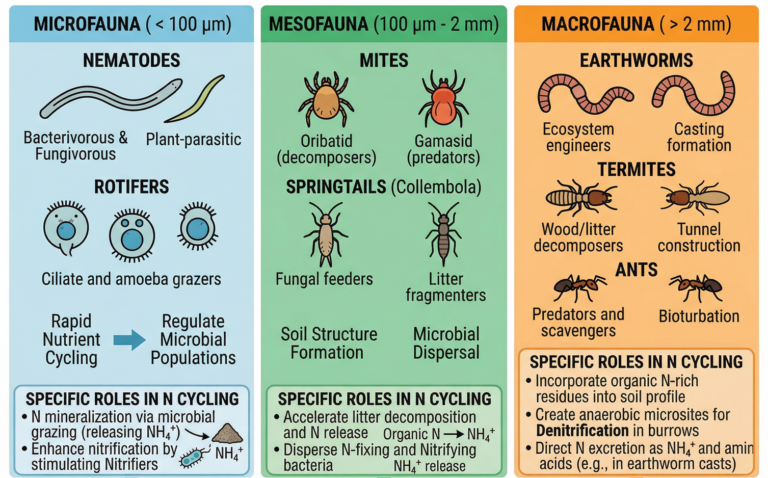
Soil fauna includes microfauna (e.g. nematodes and rotifiers), mesofauna (e.g. mites and springtails) and macrofauna – the larger, well-known ‘soil engineers’ such as earthworms, termites and ants.
While soil microbes have long been recognised as key drivers of nutrient cycling, the review highlights the need to better understand how soil fauna also shape these processes, particularly through their interactions with microbes.
That’s according to lead author of the paper, Dr Ramesha H Jayaramaiah (Murdoch University), who says earlier research had largely prioritised the influence of microbial populations and processes on nitrogen availability.
“Whenever people were talking about nutrient cycling, they were talking about soil microbes,” he says. “But what about soil fauna, these different animals in the soil?
“Who eats whom in the soil food web can indirectly regulate microbial activity and nitrogen transformations.
“It can actually speed up nutrient recycling and release plant-available nitrogen.”
The review brings together contributions from PhD students and established researchers, and provides new insights into how soil fauna may help regulate nitrogen cycling and support more sustainable agricultural systems.
Murdoch University is represented by Dr Jayaramaiah, PhD candidate Stephen Ahenda, Associate Professor Wei Xu, Associate Professor Frances Hoyle and Professor Daniel Murphy.
MORE STORIES

Mycorrhiza, rhizobia focus for PhD at Adelaide University
A PhD POSITION is available for the South Australian-based project ‘Reducing methane emissions: The impact plant symbionts (mycorrhiza and rhizobia) on saponin production in medic under water stress’.

The highs and lows of potassium application
Dr Miaomiao Cheng, Emeritus Professor Richard Bell and Dr Craig Scanlan have progressed an important correlation between a soil’s buffering capacity and cation exchange capacity.

SoilsWest to talk constraints, courses at Open Day
SoilsWest and the School of Agricultural Science will have a shared presence for Murdoch University’s annual event.

Soil carbon focus for postdoctoral research role at Curtin
Curtin University is inviting applications for a four-year postdoctoral research role in its Soil and Landscape Science Laboratory Team.