After successfully applying for a Brazilian government scholarship, Ms Araujo could have chosen any international university, but leant on the connection between Professor Bell and Professor Oliveira for her first trip abroad.
It proved a unique opportunity – and perfect timing.
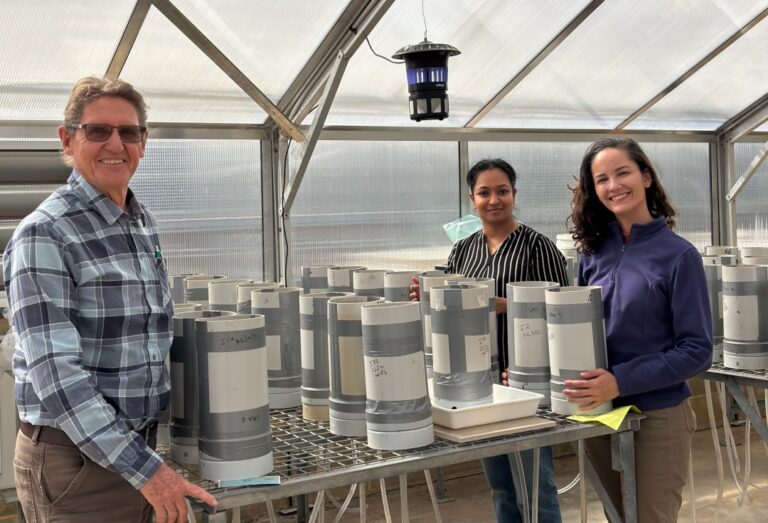
With Professor Bell having started work on the WA component of a national innovative soil technologies project, Ms Araujo was immediately able to support research into the use of nanolime to address soil acidity and potassium loss.
“The other researchers were studying nanolime in the field too, but it was in the glasshouse that we were able to trace potassium uptake,” she said.
“We already know nanolime can be a good initiative, but it’s more expensive than commercial lime and we have to be sure it’s right for farmers.
“My research in Brazil has been really different to this and I’m not even sure there’s any research in Brazil about this topic. I think it’s good research to take back.
“Although some regions share similar soil characteristics with WA, they are limited because of Brazil’s vast extensions of clay soils. The situation in WA is more urgent and requires rigorous pH corrections and prompt management due to narrow sowing windows.”
Ms Araujo’s Brazilian research has focused mainly on Oxisols in tropical high rainfall areas (>1000 mm).
Like WA’s sandy soils, Brazilian Oxisols are highly weathered, acidic and of low fertility. However, at her specific study site, the soil’s clay content exceeds 60%.
“In Brazil, sandy soils are mainly found in coastal areas and agricultural expansion frontiers such as Western Bahia and the MATOPIBA region,” she said.
“Our main grain and fibre production – such as soybean, corn, and cotton – is concentrated in the centre-west states of Mato Grosso, Mato Grosso do Sul, and Goiás. This is where my experimental site is. UFV is in Minas Gerais but conducts extensive research for these highly productive tropical systems.”
Ms Araujo aims to complete her PhD research on soil fertility, nutrient dynamics, and soil health in long-term conservation agricultural systems by February 2027.
Her work integrates studies on phosphorus management under no-tillage, investigates nutrient cycling by cover crops and assesses soil health using the BioAS/FertBio framework developed by Embrapa, the Brazilian Agricultural Research Corporation.
“In Brazil, phosphorus management is a major challenge because of the high phosphorus fixation capacity of tropical soils,” she said.
“We are investigating whether current soil sampling methods adequately represent phosphorus availability under long-term band fertilization.”
Building on her master’s studies into soil carbon dynamics, Ms Araujo’s research also extends to how conservation farming systems can improve resilience, sustainability, and profitability for farmers under changing environmental and production conditions.
Ms Araujo gratefully acknowledges the Postgraduate Program in Crop Production, where she is a PhD candidate, the Postgraduate Program in Soil Science, where this research was conducted, and the Coordination for the Improvement of Higher Education Personnel – Brazil (CAPES) for financial support through a doctoral scholarship (Finance Code 001).
The Innovative Soil Technologies to Foster Resilience and Climate Smart Crop Production in Australia Project is supported by the Australian Government through funding from the Climate-Smart Agriculture Program under the Natural Heritage Trust, administered by the Department of Agriculture, Fisheries and Forestry (DAFF).