CHEMISTRY is a lot easier than agriculture.
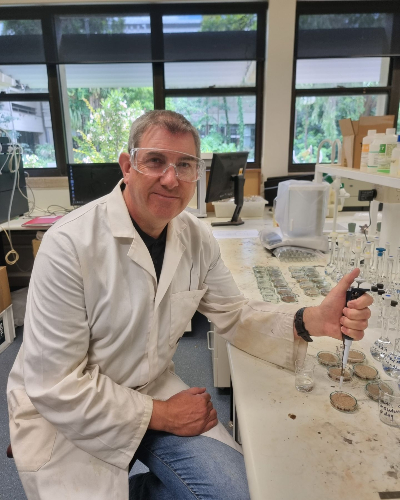
That’s the sentiment of Murdoch University‘s Professor David Henry, who says he’s not a soil chemist, but a chemist who’s interested in soil.
He recalls an early connection with colleague Professor Richard Harper on the topic of hydrophobicity – the chemical property of a material to repel water.
“One day Richard’s asked, ‘Does anyone in Chemistry know anything about hydrophobicity?’
“And I’ve responded, ‘Well, I used to work on paints and they are often hydrophobic. What would you like to know?'”
Fast forward more than 10 years and, through the investment of the Grains Research and Development Corporation (GRDC), Professor Henry is extending the soil water repellence work once led by the Department of Primary Industries and Regional Development.
His new research is in its baseline measurement phase; analysing 220 pre-seeding soil samples from existing grower group trials with another 220 post-harvest samples to be collected for comparison.
Which molecules are responsible?
Professor Henry says soil water repellence is “unavoidable”, particularly in Western Australia’s sandy soils, but answers to improved amelioration may eventually be discovered at the molecular level. (Soil water repellency is caused by organic molecules coating the surface of the soil particles.)
“There can be hundreds of different types of organic molecules in the soil but they don’t all cause water repellency,” he says.
“Part of our work is to identify the types and amounts of the molecules responsible for causing water repellency. We carry out experimental work to isolate and quantify the different organic compounds in soil samples and relate these to water repellency measurements.”
By also building computer models of organic molecules and soil particles, Professor Henry and his team are closer to understanding how those molecules interact with sand and clay.
“There’s a lot of work that goes into building the models, and we can’t model the full complexity of organic matter in soil – it’s too complex,” he says. “Instead, we tend to deal with one or two things at a time and learn about their contributions to water repellency. Then we build up our understanding from all the different soil properties.
“As I say, I am a chemist interested in soil, not a soil chemist. I know about soil types like Arenosols and Sodasols, but what I am really interested in is what’s going on at the surface of the soil particles and the interaction between these particles and soil organic matter.”
What’s in a wetter?
Grower feedback to the GRDC has highlighted annual soil wetter dependency, difficult starts to the season, spatial variability of soil water repellency expression and the impact of crop and pasture residues as ongoing issues.
Professor Henry says he had initial concerns about the legacy effect of wetters. Even though surfactants can reduce surface tension, therefore aiding water absorption, the molecular structure of some surfactants is very similar to the compounds that cause water repellency.
“It turns out that most of the current generation of wetters are not simple surfactants but are in fact polymers that will behave differently in soil and when interacting with soil organic matter,” he says.
“We don’t actually know how these wetters work in soil at a molecular level. What are the molecules doing and how are they arranged? They help to wet up the soil, but why? That’s what we will try to understand.”
The legacy effect of certain crops, while more conclusive, also leaves questions for the lab.
“Lupins are anecdotally notorious for causing water repellency, but can we quantify that? What organic compounds are the lupins leaving behind and how does that compare with the effects of other crops?”
Professor Henry says despite the volume of his research and teaching commitments, he enjoys the opportunities to get out in the field to speak with farmers about their soil constraints.
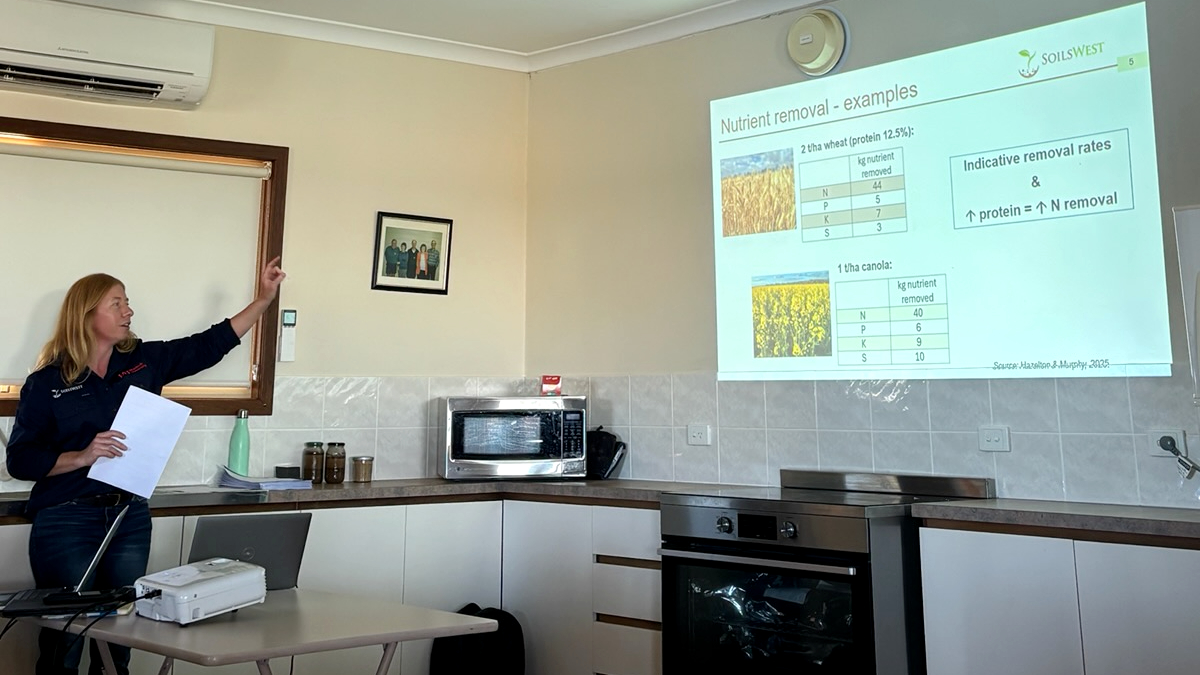
In August, he presented on ways to address non-wetting soils at the Northern Agricultural Catchments Council Field Day in Dandaragan, an event that was also attended by Nick Eyres (Greenough Specialty Agriculture).
This research is being undertaken with investment from GRDC: Development of Soil Water Repellency Management Options for Australian Grain Growers, UMU2501-005RTX.