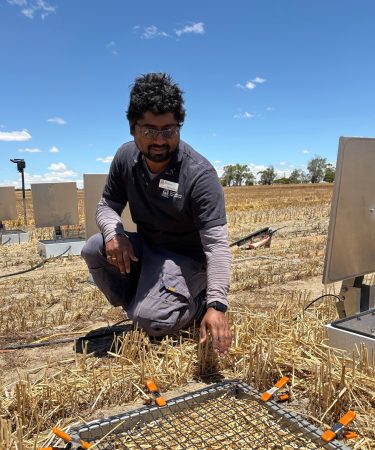
For almost two years, Dr Banik and his DPIRD colleagues have been conducting GHG monitoring for N2O, carbon dioxide (CO2), and methane (CH4) using semi-automated chamber technology linked to gas analysers, soil processing, and data coagulation.
Associate Professor Barton and Dr Craig Scanlan, who joined UWA from DPIRD early this year, have provided expertise in data interpretation and emissions modelling.
“One of the consistent observations from WA studies is that N2O emissions are highly dependent on rainfall patterns. Earlier work by Associate Professor Barton demonstrated soil N2O emissions tend to occur in short-lived pulses after rainfall during the summer-autumn fallow, when soil moisture and temperature conditions favour microbial activity, and there was an absence of active plant growth,” Dr Banik said.
“Our soils are generally drier for longer periods, and the emission events we observe tend to be concentrated in relatively short windows. Outside those periods, emissions are often very low.
“Because of that, our semi-automated chamber system is programmed to intensively monitor emissions around rainfall events, allowing us to capture the periods when nitrous oxide losses are most likely to occur.
“It also helps us to identify exactly when emissions occur, how long they last, and whether crop residues are contributing to those rainfall-driven spikes.”
“Australian on-farm calculations currently use international default values to estimate soil N2O emissions from the mineralisation of crop residues,” Associate Professor Barton added.
“The international value may be overestimating the contribution of crop residue mineralisation in Australian cropping system. Our goal is to generate Australian specific values, so that growers and industry can calculate emissions using estimates that better reflect our local environment.”
GHG fluxes are measured using semi-automated static chambers programmed to close at scheduled intervals, particularly before and after rainfall events, and collect gas samples from the soil surface.
Gas samples from the chamber headspace continuously circulate to a gas analyser for 60 minutes at any measuring period, recording changes in concentrations for N2O, CO2, and CH4. Concentrations are recorded at three time points during each chamber closure, and fluxes are calculated from the rate of change in gas concentration over time.
“By having one treatment with above-ground residues and one without, we can calculate the emissions that occur when a grower leaves residues in the paddock,” Dr Banik continued.
“One of the strengths of this project is that we’re measuring emissions continuously across seasons rather than relying on occasional sampling.
“That allows us to capture the short-lived emission pulses that can occur after rainfall events associated with residue decomposition, giving us a much clearer picture of what is happening.”
Alongside GHG measurements, residue decomposition and inorganic nitrogen application, the project is also monitoring soil moisture and soil temperature to better understand the environmental factors controlling N2O production in WA cropping systems.
For WA growers, it seems a combination of climate, soil type and crop selection ease the N2O emissions conundrum faced by their eastern counterparts.
“The eastern states often have more rain, the soil types hold more moisture, and there are preferences for other crop varieties like faba beans, maize and sorghum,” Dr Banik said. “We have a very different environment.
“The evidence so far suggests that our low-rainfall Mediterranean environment does not create the same conditions for N2O production that are often observed in higher-rainfall regions of eastern Australia.
“While residues are an important source of carbon and nutrients for soil health, our observations indicate they may contribute relatively little to overall N2O emissions in many WA grain-growing environments.”
Dr Banik’s experiment concludes in November.
This research is being undertaken with investment from GRDC in Quantifying Greenhouse Gas Emissions from the Decomposition of Crop Residue, QUT2401-001RTX.