AGGREGATE: NEWS & EVENTS

Research spotlights soil fauna’s role in nutrient cycling

A review led by Dr Ramesha Jayaramaiah provides new insights into how soil fauna may help regulate nitrogen cycling and support more sustainable agricultural systems.
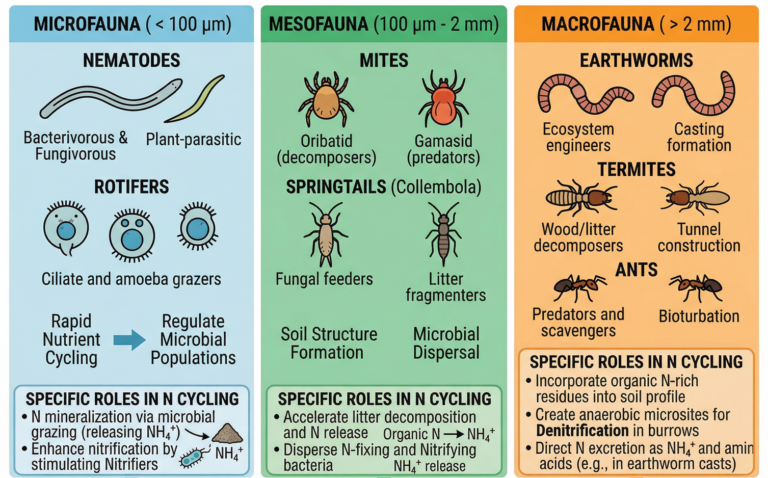
Infographic showing soil fauna and their roles in nitrogen cycling
X
LinkedIn
Email

HOW CAN soil fauna influence the release, retention or loss of nitrogen – the element essential to crop production?

Researchers from Murdoch University, The University of Melbourne and Western Sydney University have explored the possibilities in their Geoderma review, ‘Uncovering the functional roles of soil fauna in nitrogen cycling and agricultural sustainability’.

Soil fauna includes microfauna (e.g. nematodes and rotifiers), mesofauna (e.g. mites and springtails) and macrofauna – the larger, well-known ‘soil engineers’ such as earthworms, termites and ants.

While soil microbes have long been recognised as key drivers of nutrient cycling, the review highlights the need to better understand how soil fauna also shape these processes, particularly through their interactions with microbes.

That’s according to lead author of the paper, Dr Ramesha H Jayaramaiah (Murdoch University), who says earlier research had largely prioritised the influence of microbial populations and processes on nitrogen availability.

“Whenever people were talking about nutrient cycling, they were talking about soil microbes,” he says. “But what about soil fauna, these different animals in the soil?

“Who eats whom in the soil food web can indirectly regulate microbial activity and nitrogen transformations.

“It can actually speed up nutrient recycling and release plant-available nitrogen.”

The review brings together contributions from PhD students and established researchers, and provides new insights into how soil fauna may help regulate nitrogen cycling and support more sustainable agricultural systems.

Murdoch University is represented by Dr Jayaramaiah, PhD candidate Stephen Ahenda, Associate Professor Wei Xu, Associate Professor Frances Hoyle and Professor Daniel Murphy.

Aggregate: News & Events

MORE STORIES

DPIRD seeking lead research scientist

JOB OPPORTUNITY: DPIRD has advertised for a Principal Research Scientist (Level 4)/Senior Research Scientist (Level 3) for its Soil Science and Crop Nutrition branch.