THIS TIME last year, Maria Pfeifle was putting the finishing touches on a Murdoch University PhD in Agricultural Science with a research focus on soil water repellency and soil spectroscopy.
Through funding from the Soil CRC‘s ‘Integrated Soil Management Solutions’ program, her research gave her a real sense of what it could be like to work as a scientist supporting Western Australian growers.
Pfeifle is now three months into that very role at the Department of Primary Industries and Regional Development (DPIRD) in Northam, but her scope has switched from water repellency to potassium and nutrient management.
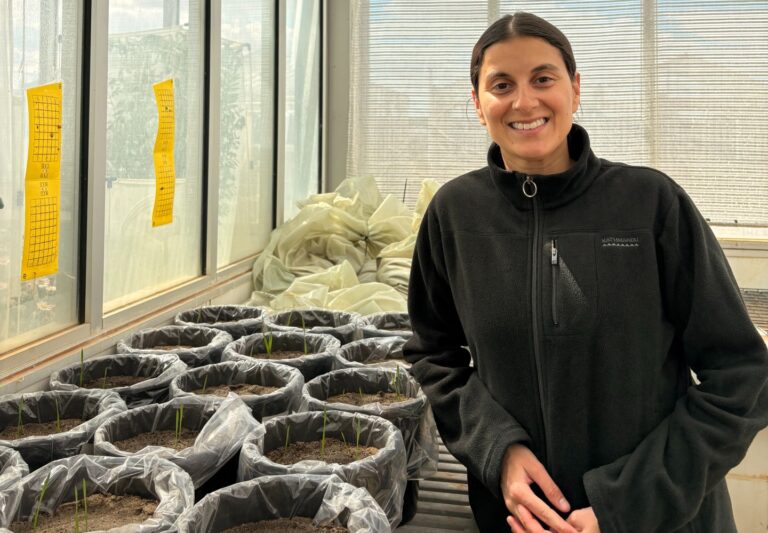
“This area of research is new to me, and it’s been really good to work out of DPIRD Northam, where they’ve got glasshouses, greenhouses, plant and soil laboratories, and on-site experimental facilities,” she says.
“It’s the agricultural research hub for the Central Wheatbelt.”
Pfeifle’s potassium tracing research is part of the Soil Water and Nutrition (SWAN) project, a strategic collaboration between DPIRD and the Grains Research and Development Corporation (GRDC).
She said early research proposed using rubidium, a more affordable alternative to the stable isotope of potassium (41K), to study uptake and potassium use efficiency in plant-soil systems within WA’s dryland cropping region.
“While rubidium has the potential to be used as an analogue for potassium, we’re doing pilot studies to confirm this because there’s not a lot of research on this,” Pfeifle says.
Where suitable, research using the substitute element could help with identifying the fate of potassium in both the plant and soil and inform farmer fertiliser decisions.
“Because current potassium levels in some WA agricultural soils are quite low – potassium is often leached with heavy rain in sandy soils with low cation exchange capacity – farmers are applying from 10 to 40 kg of fertiliser per hectare to their farms,” Pfeifle says.
“It is obviously expensive to add these fertilisers, so we want to know how efficiently potassium is being taken up by the crops and how this might affect yield, as well as identify any losses associated with leaching.”
Pot experiments started in Northam’s glasshouses earlier this month.
“We’ve added rubidium to the soil, mixed it up and are currently letting it equilibrate prior to seeding,” Pfeifle says.
“We’re going to start sowing wheat, canola and lupin under controlled conditions, and test whether the ratio of rubidium and potassium is stable and can be used as a method to quantify crop uptake and losses associated with leaching.
“We’re still in the early stages, so watch this space.”
This research is being undertaken with investment from DPIRD and GRDC in the Soil Water and Nutrition (SWAN) Strategic Collaboration, DAW2407-001SPX.